
Law Of Closure - Gestalt Laws of Perceptual Organization
Discover the power of the law of closure, one of the most important Gestalt principles, and how it can improve your web design and web development.

Web design and web development are not only about creating functional and attractive websites, but also about understanding how users perceive and interact with them. One of the key aspects of user experience (UX) and user interface (UI) design is the application of Gestalt principles, which are a set of psychological rules that describe how humans organize visual information into meaningful patterns and groups.
One of the most important Gestalt principles is the law of closure, which states that our brains tend to fill in the gaps and complete incomplete shapes or forms. This principle helps us simplify complex or ambiguous stimuli and create a sense of order and harmony. In this article, we will explain what the law of closure is, how it works, and how it can be applied in web design and web development to improve UX and UI.
What is the law of closure?
The law of closure is based on the idea that our minds prefer to see complete shapes rather than fragmented or incomplete ones. When we encounter a shape that has missing parts or gaps, we automatically fill in the missing information and perceive it as a whole.
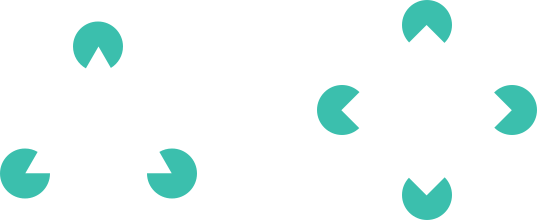
In this image, we see three circles that are partially covered by a triangle. However, our brains do not perceive them as separate shapes, but as a single entity. We ignore the gaps and complete the circles in our minds, creating a sense of closure.
Why is the law of closure important for web design and web development?
- It reduces cognitive load and increases comprehension. By using the law of closure, we can simplify complex or cluttered layouts and present information in a clear and concise way.
- It creates visual interest and engagement. Users are more likely to be attracted by shapes that are incomplete or have gaps, as they trigger their curiosity and imagination.
- It enhances brand identity and recognition. Users are more likely to remember shapes that are unique or have gaps, as they stand out from the rest and create a lasting impression.
How to apply the law of closure in UX and in UI?
- Use white space strategically. White space can be used to create gaps or boundaries between elements, which can trigger the law of closure and help users group them together or separate them apart.
- Use icons or illustrations creatively. Icons can be used to create shapes that are incomplete or have gaps, which can trigger the law of closure and help users recognize them easily.
- Use typography cleverly. Typography can be used to create shapes that are incomplete or have gaps, which can trigger the law of closure and help users read them faster.
Conclusions
The law of closure is one of the most powerful Gestalt principles that can be applied in web design and web development to improve UX and UI. By using this principle effectively, we can create websites that are more user-friendly, intuitive, attractive, memorable, and distinctive.
Other Gestalt Laws
Check out the other five Gestalt laws in our following articles:
Bibliography
[1] M. Boulton, “Gestalt Principles: How Are Your Designs Perceived?”, Smashing Magazine, 2010.
[2] J. Sauro, “The Law of Closure: The Gestalt Principle That Can Improve Your UX”, MeasuringU, 2018.


